
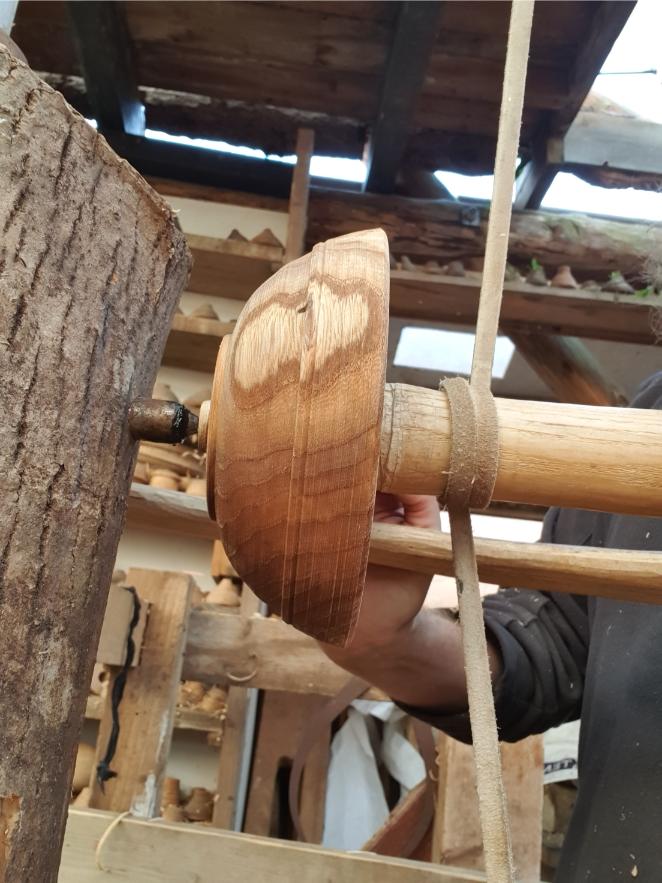
Masters of Slojd Review – Robin Wood
A few weeks back Carolina Smoorenburg organised her latest Masters of Slojd event. These events are zoom calls which any interested crafter can dial into, and each time they interview a variety of great craftspeople. On 26th February 2026, it was the turn of Robin Wood to talk about his days on the pole lathe. Following the event a number of crafters got in touch to express regret that they had missed it, and so I committed to write a little summary, linking it to my own experiences. It is a shame that these zoom calls are not recorded, but perhaps an incentive to follow @carolinas_slojd and keep informed on what is coming up.
(Disclaimer: as this was a few weeks ago and I only made limited notes during the event this didn’t capture everything, and I’m sure I’ll paraphrase Robin in a few places, but hopefully won’t put words into his mouth that he didn’t say. If any of you reading this feel that I have, then please let me know and I will adjust accordingly!)
Robin began by detailing his journey into bowl turning from his early days in forestry. He stated he was looking for a job that uses body and brain, which involved significant time outside (not in an office!), and in which he had the opportunity to build community. He may as well have been describing me eight years ago when I quit my job as a software engineer!
I was lucky to arrive on the scene once the APTGW was well-established and with the inaugural bowl gathering having occurred the previous year and great tutors available including Sharif Adams and Owen Thomas. Robin had none of those. When he attended the second Bodgers Ball there was only one person there turning bowls, a gentleman called Will Wall, who had adjusted a spindle lathe and was primarily using a bowl gouge to do the work. There was however George Lailey’s lathe in the MERL museum in Reading (subject of a previous blog I did) which he visited, examining all the tools etc. Also in his forestry job he also had access to a forge and copious amounts of wood. (Nb. I am aware there were a few other turners around at this time too, but for sure there was less knowledge than there is now.)
In time Robin took the decision to become a full-time bowl turner. He estimated that he was making 15-20 bowls a day and had made over 25,000 in total. As he freely admits, he likes hard graft! For context I currently can comfortably do about 8 bowls a day, but I can see how it would be possible to reach those levels especially now I’ve made updates to my lathe to be more ergonomic. Most of the time he was turning 2 and 3 bowl nests, although he did achieve a 6 bowl nest one. In the questions which occurred later, he was asked how he sold all these bowls. His answer was that they were probably sold a bit cheap at the time (£20 each), but it was clear that his passion for encouraging people to eat from a wooden bowl definitely made a difference. He recalled how elderly people in Spain talked about the bowl they ate from when young as like an old friend. Making people realise that they not just buying a bowl, but something they will build a relationship with (as I suppose all purchases are), helped to sell them.
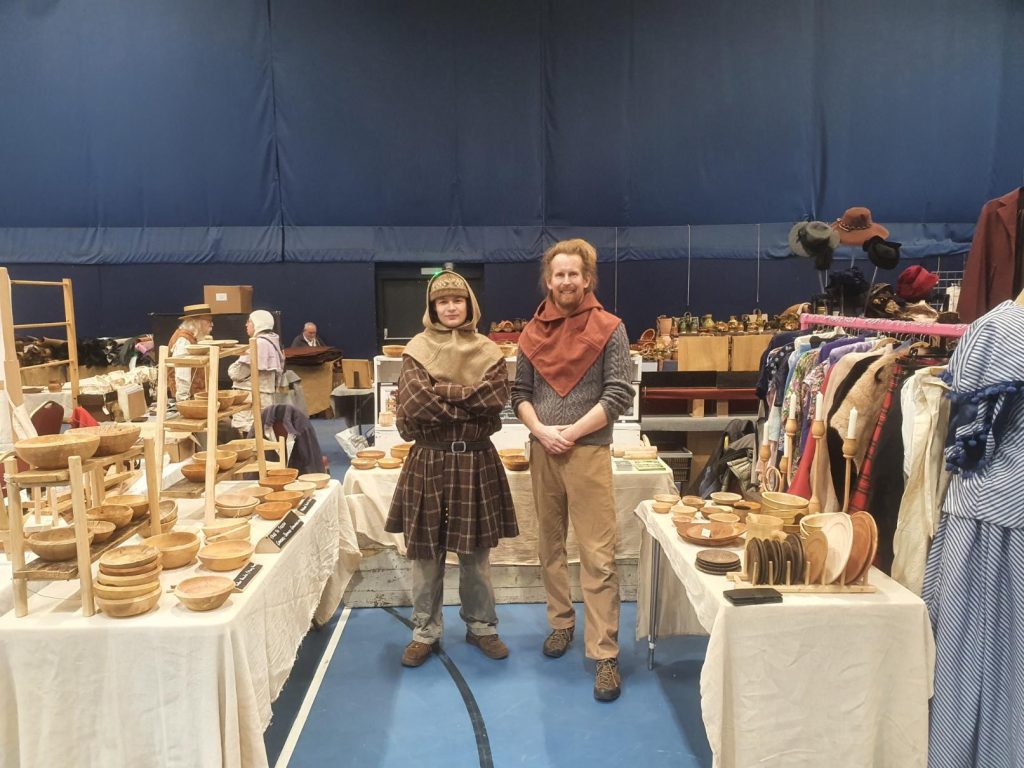
A lot of the bowls he made were for the re-enactment community and he mentioned TORM (which I currently sell at) and also the Mary Rose with its incredible 450 items of treen. I honestly had no idea it was that many, and he told us about a book called ‘About the Mast’ that has more photos and info of those finds. I’ve just ordered a copy of that book! Regarding TORM, I am selling OK there, but everytime new people come up to me and say “Oh I love wooden bowls, I’d buy one, except I still have the one I bought from Robin 20 years ago”… maybe we should all just be ceramicists! 😉 Now I’ve been along three times, I’m finding people bringing along their bowls by Robin to show me how well they have aged!
On the topic of books, Robin of course wrote the excellent (now out of print) book ‘The Wooden Bowl’. His feedback on that was that it never made him any money once all his research travels and time were taken into account. It is a testament of his devotion to the topic though and I for one am glad he wrote it. My plan is still to write my own e-book for later this year with lathe plans and brief comments about ergonomics, with a view to a bigger book in the next few years.
Robin showed a variety of work he had either collected or turned, and it was clear that he has always enjoyed experimenting with different things. From making his own egg-based paints, to soaking bowls in peaty water to age them. It is a good kick up the backside to try some of the many experiments I have been thinking of doing (beyond those I do already).
After about ten years of continuous turning he had started teaching spoon carving and through that developed the Wood Tools brand with Zak as his apprentice. This came about as he perceived there was a lack of affordable quality tools out there for the job. In time this became his focus and the turning slowed down considerably. Change is afoot again though, as he has recently moved to Scotland with large renovation plans for a property he has bought and a desire to start making more crafted items again. In doing so he’ll be stepping back from the Wood Tools business.
We then got onto the questions at the end. I asked one about advice on poles and tuning those poles. Robin replied that he mostly used bungee in the workshop, but when demonstrating he had good success with ash, larch and rowan. Larch and ash were also mentioned by Joseph Hughes in Tools and Trades (Vol 1)as being a good wood for turning. As for sizing, around 18ft going from 3.5” diameter at the base to 1.5” at the bowl. Ensure there are no side branches and minimal taper. Ideally they would be fast-grown as well for more bounce. Thinnings from forestry are ideal as they have shot up for the light with minimal side branches. My quest to find the perfect pole continues and I am none the wiser regarding tuning the pole for different weight objects, but in the meantime I have more confidence using bungee knowing Robin used it for so long.
The inevitable oiling question came up. Robin explained that he had simply dipped his everyday treen in hot linseed oil and given them a wipe, but he had also experimented with other finishes. There was a big carved bowl which he had applied a finish to that was incredibly waterproof and durable. In typical mind-wandering fashion, I switched off when he gave the details though!
There were a few questions related to museums with recommendations to visit Lubeck and Konstanz in Germany and Soro in Denmark and of course the Vasa in Sweden. He also recommended looking at the bibliography in the rear of his Wooden Bowl book for more inspiration.
By far the most interesting answer for me related to sharpening though. When asked how he sharpened he said on the inside of the hook with a tickle of a flat stone to remove the burr, but it was what he said next that blew my mind with its simplicity. He went on to describe how each turner would tend to stick to a few known products and crucially just one type of wood (that grew near them). In doing so, they understood how best to cut that tree, and Robin suggested that different bevel angles might give better results for different woods. Alder for example would need a shallow bevel to get a clean finish, but for harder woods such as ash a steeper bevel would be needed so that sharpening doesn’t have to happen all the time. Of course sharpening was made easier for him as he had over 100 hooks to choose from!
Finally, I want to mention something he said which I disagree on. He stated that twice turning bowls was not something that happened. I have the evidence that George Lailey was twice turning bowls at some parts of his career. I believe big bowls going back some time were also twice turned given their flat bottoms. I have not tried this out yet, but rest assured I will do in the future and perhaps some of you will too. I do not make this point to criticise Robin, just merely to suggest that we are all responsible for discovering more about this craft and if it is left to one person it is possible that mistakes can be made. At some point I’ll get in touch with him to discuss these thoughts and also talk backrests etc, but for now I am quite busy and it sounds like he is too.
I am indebted to Robin for the work he has done thus far to resurrect bowl turning, and greatly appreciated hearing him speak about his journey. I found It very inspiring. Thanks also to Carolina for organising it. Go check out the upcoming Masters of Slojd sessions and consider giving them a donation (as there is a fair amount of effort involved and the sessions themselves are free). Robin’s website is here, there you’ll also find his great blog with many still relevant articles to read today.
Once again, please leave any feedback you have below and do get in touch if I’ve mis-quoted anything to the detriment of Robin or myself. Thanks 🙂
Fascinating. Robin is responsible for the birthing of many bowl lathes worldwide. It’d be fascinating to map visually. I’ll buy your book! Close up photos of tool on wood please. Maybe a short series on YouTube behind a paywall? Monthly zoom masterclasses? Fabulous content thanks
Thanks Rory, loads of great ideas there. All the best, Geoff