
A Visit to Jean Paul Rossi
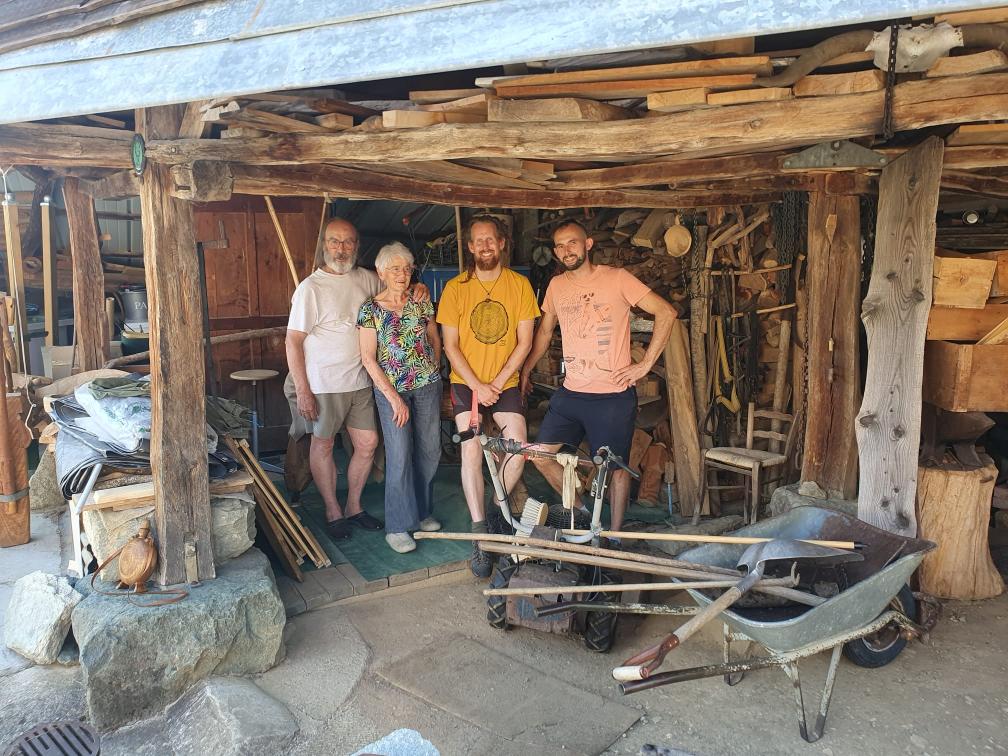
Recently my partner and I visited the South of France to see some old friends. I couldn’t help but notice that we were travelling within 30minutes drive of a ‘youtube famous’ pole lathe turner who has been practising for some time. Given one of our friends spoke perfect French to act as the ‘traducteur’ (translator), it seemed like too good an opportunity to miss. This article is hence dedicated to my long-suffering partner, Miri, her friend Maz, and child Marlowe for entertaining themselves whilst Michael and I visited Jean Paul Rossi in his home in the Les Bauges region of Thoiry, France.
Those of you who have trawled youtube scouring endlessly for video of pole lathe turners will doubtless have come across Jean Paul and the Argenterie de Bauges (Silver of the Bauges region) which he makes. Some of you may even have read the book of the same name which crops up occassionally on ebay.
There aren’t many people with his experience of the pole lathe left in the world so I was keen to visit and see if I could glean anything useful. The first thing to say is that Jean-Paul and his wife Madeliene were incredibly kind and welcoming (as soon as they realised that we were actual turners and not ‘people in suits’ as Jean Paul called them 🙂 ).
Jean Paul has been turning since he was 15, and is now in his late 70’s. He no longer pole lathe turns, but still dreams of ways to improve on the lathe. His current fascination is on how big bowls were nested on the pole lathe, and if stopping their rotation on the upstroke (to reduce the risk of catches when nesting) was something that the old turners did. We chatted for a good hour or two on this without consensus, but something to try when I get back to big bowls one day. He got his job as a sports teacher to enable him to have time in the holidays to pursue his woodturning interests. Initially this was on a powered lathe, but in 1995 he started pole lathe turning, and is now convinced that it is a better way to turn.
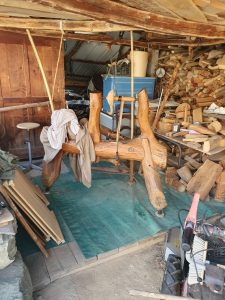
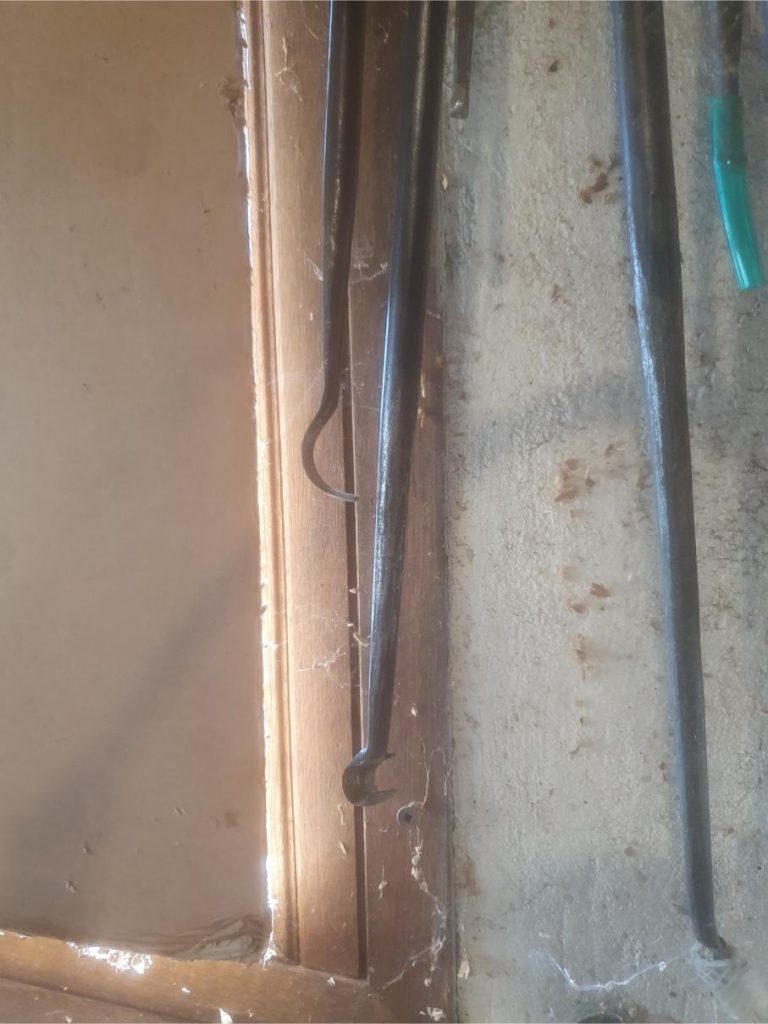
With a local blacksmith he forged many different hooks (‘Crochets’) and tried multiple handle designs. He also had some hooks cast in very strong steel in Canada by Andre Martel. These are virtually indestructable and hardly ever need sharpening. His demonstration lathe is utterly unique in its toolrest support and the fact he is sat down when turning. Being comfortable when turning is super important to him, so as you can imagine we had lots of good chats about the lack of back-rests in the pole lathe world currently ;-). I also noticed the three wedge solution on his lathe, this comes from his time riding horses and each saddle always had three clips. So the first hole approximately tightens the poppet, the second makes it fully secure, and the third is a back-up (presumably only used if something big is being turned). As someone who feels they have to thwack the wedge quite hard to make it stick, this is something I may experiment with myself. In his videos it looks to be not more than a gentle nudge he has to give the wedge.
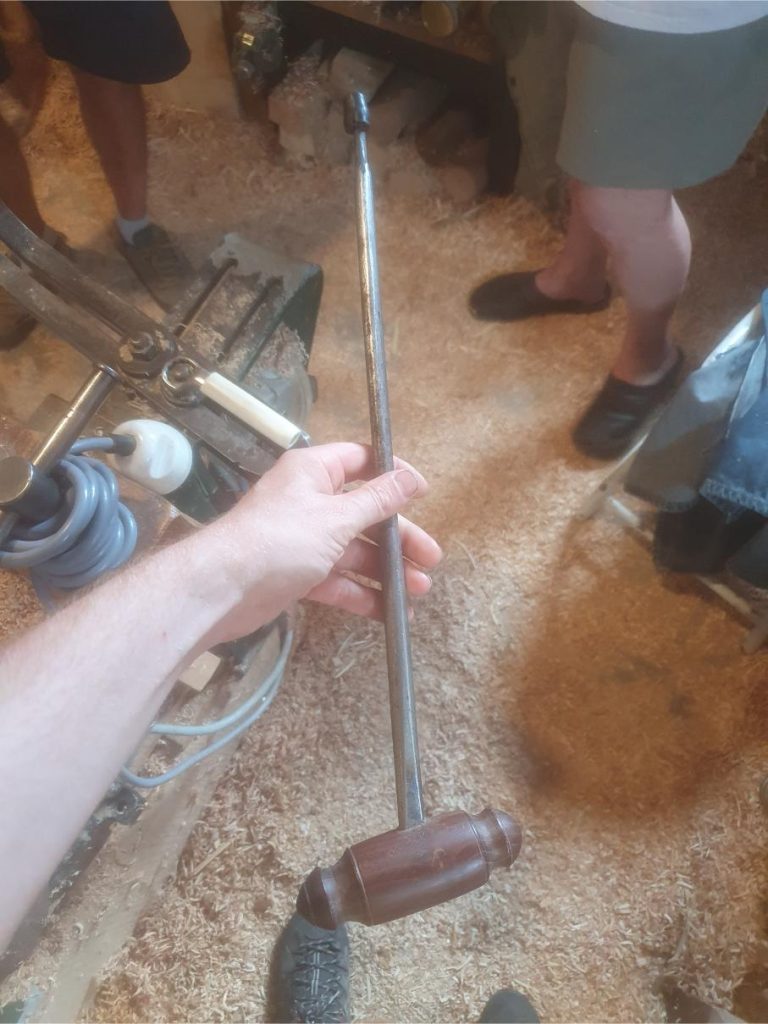
There was a village of turners (La Magne) near him where he was able to go quiz one of the old turners to give up his secrets on the pole lathe. I asked if there was anything special about this lathe or if I could visit, but Jean-Paul assured me it was not worth visiting as it was the same as others I’d already seen. I have since seen a drawing of this lathe in his book and what struck me was the toolrest arrangement and options for altering it. Maybe I’ll have to go back and visit again one day! This adjustable toolrest setup was probably related to the Poche (a stop-turned ladle) which they made traditionally in the area. I’m looking forward to one day having a go at one of these, but they look tricky and for sure a novel toolrest setup will be required.
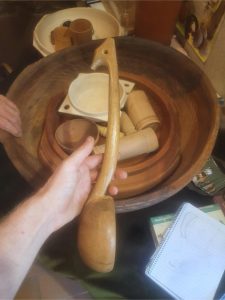
A recent realisation is that pole lathe design firstly comes down to what are you trying to make. It is noticeable how past artisans tended to focus on just a few items to make, and had very specific centre heights, toolrest setups and tool handle designs based on those items. it makes it hard to produce one design of lathe which can ‘do-it-all’. We all have to take responsibility for adjusting our lathes so that our bodies are comfortable whatever we are turning.
I also enjoyed chatting with him about the flasks or ‘boteillons’ which were also a staple of the area. His region made them for the whole of France and other woodturners have tried and failed to replicate them. You need to really understand wood to make these items and I feel I am some way off being ready, although I do now know a thing or two which should make the task easier. Until I’ve made a few I’m obviously reluctant to share these secrets, as I do not fully understand them yet.
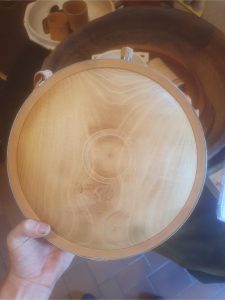
He has a museum of these items and it was noticeable how he spoke with reverence of these old turners and how their work far exceeded his despite devoting a lifetime to the craft. It made me realise how my journey is still only just beginning.
It was a pleasure spending the day chatting wood with him and I feel sure we could have chatted further. Having done it for so long he has distilled the complexities down into a quite simple philosophy to woodturning which I now use everytime I teach:
1) Make sure your tool is sharp.
2) Put the edge on the object to be turned in the right location.
3) Make sure you are standing comfortably and not over-gripping. In other words adjust your standing position so the tool is comfortable in both hands and touching the body (usually the shoulder) with minimal twist to your spine. Then move the backrest so you are supported.
4) Let the shavings fly!
Finally, a very large thank you to my friend Michael Bortoluzzi for being the ‘traducteur’ for us both. Both Jean-Paul and I got so much out the day as usually happens when two passionate craftspeople meet, and this was only possible due to Michael’s presence.
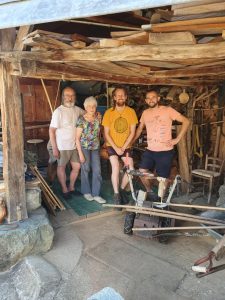
Here’s a link to a video of Jean Paul. Here’s a link to his website.
I do hope you find this useful and if you want more detailed information then do get in touch.
Interesting article Geoff. Thanks for sharing this.. Makes me realise just how much more there is to learn and understand !