
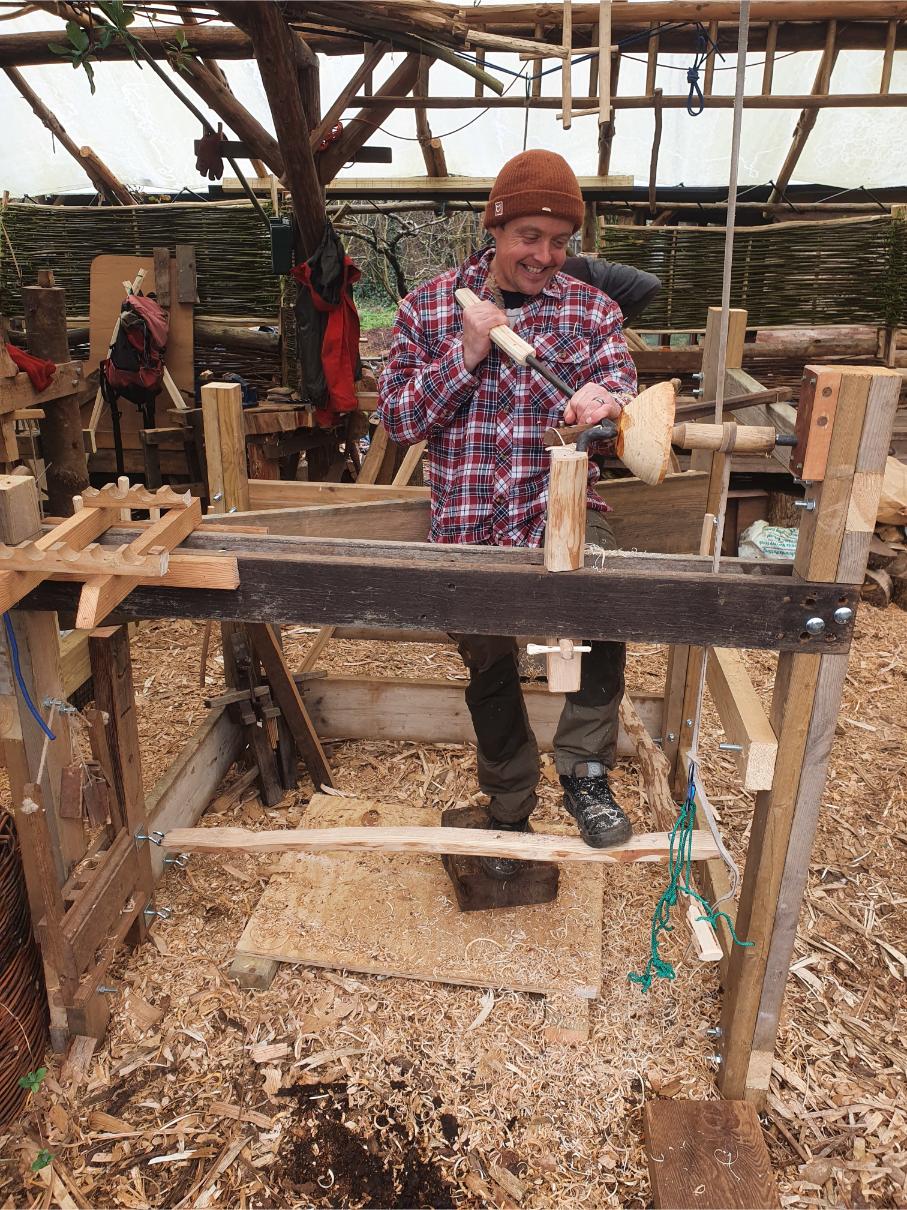
Pole Lathe Update
In a couple of weeks the 2026 Bodger’s Ball will be held at the Avoncroft Museum just South of Bromsgrove. I’ll be bringing along a portable pole lathe I have designed mostly from easily accessible 2×4 wood which can be set up for cups, bowls or spindle turning, and has all the ergonomic features on my lathe in the workshop. This blog is a little more information about the design and my next steps for it. As such this blog is aimed at the existing and wannabe turners amongst you.
Back in Winter 2025 when my body was quite broken and I realised that no-one else seemed to be looking into lathe ergonomics in the level of detail I wanted, I looked at many old photos and articles and bolted some bits of wood to my old lathe (the ‘frankinlathe’), and quickly found out that a backrest was very useful. So I built a big permanent lathe (the ‘megalathe’) in my workshop and have been turning on that and tweaking it ever since. I was then faced with a dilemma… what do I demonstrate on and what do I teach on? I had already put a lot of time into R&D for the megalathe, but having toyed with the idea of pegging my existing flatpack/viking*/travel/bowl lathes down to the ground and simply sitting in a sling hanging off the bed, I decided that a total re-design was going to work better in the long-term for me (for reasons I explain later).
* No-one seems to really know why this lathe is called a viking lathe, there is certainly no evidence I know of that the vikings used lathes like this. It could have even been a strap lathe. Anyhows, I imagine it came from reenactors using this lathe design as it is so easy flatpack and travel with. For the sake of clarity though I’ll refer to this as a flatpack lathe throughout this article.


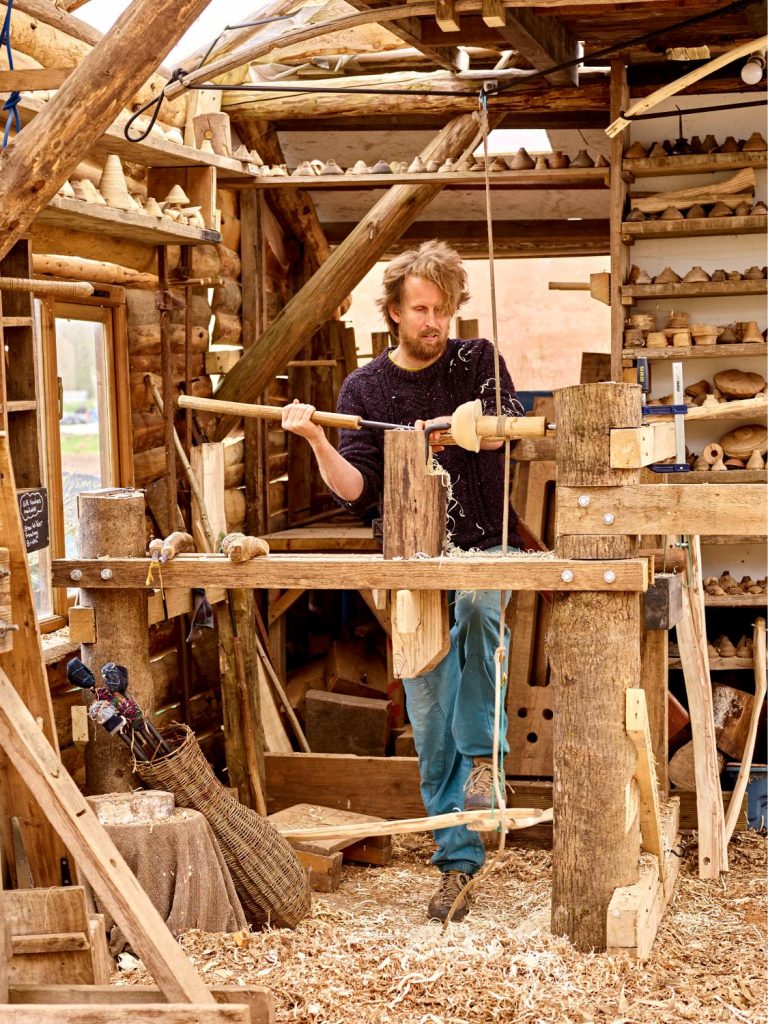
So this winter I have been building a lathe to demonstrate on, and to offer ‘collaborative’ teaching opportunities at the festivals I attend. Having now proved the concept, I plan on building three more lathes for my workshop so giving five lathes which can be taught on. The experience of building these three lathes should nail down the design such that I can release the design as an e-book later this year. I do hope lots of you will decide to either come try these lathes, or build your own from the plans. I’m sure there’ll be some improvements discovered once the ‘hive mind’ is unleashed, and it is not left to me caught up in my own thoughts!
So firstly, why did I choose this path rather than adjusting what I already have? The first reason is that I want a lathe that can work on hard-standing, so not pegged down. The main reason though is that travelling between festivals and woodland workshops with a whole fleet of lathes is a pain in the proverbial backside. An ideal solution in my opinion, is that these workshops and festival spaces have a set of lathes built that are to the same design, thus meaning that tutors can travel around the country and teach at each site easily. I have been trialling this with Yoav and Flo both teaching in my workshop on lathes I’ve pre set up, and it seems to work very well. I know this may not happen immediately, and it may not happen at all (it is after all quite an investment of time and money), but it is my vision of how I could actually make a living from making and teaching the pole lathe. For sure I couldn’t keep moving my lathes around from a to b and back again! If all else fails, I shall just teach from my workshop in Bristol. A third reason is that I want to make life as comfortable as possible for beginner turners to encourage them into the craft. At this point, I would like to state that the existing flatpack lathes are still perfectly fine to turn on if you find them comfortable and adjust them for your height. It worked fine for me for five years. However I believe a pole lathe with a back rest should be used if you are turning as part of your income, as it means you’ll be turning bowls for longer before injury. I am also convinced that it is right that beginners are offered the chance to learn on a lathe with a backrest as I have a responsibility to make the first experience as comfortable as possible for my customers. It is also my experience that turning with a backrest allows you to be more efficient and turn for longer, particularly with bigger bowls.
So my design needs to focus more on being cheap and quick to build rather than easy to transport. It also needs to be relatively quick to assemble/disassemble for demonstrations. It also needs to work for the courses I currently teach: bowls, cups, spindles and reifendrehen. The final thing it has to do is to be adjustable for different height turners. (Nb. It is not currently in the design brief I’ve set myself to make it fit in at re-enactment markets, but it would be fairly easy to age the timbers and hide the metal bolts with wooden caps. The ironmongery in the pedals is easily replaced with metal staples etc, so yeah I think it can be done, but as I say, not part of my current plan.)
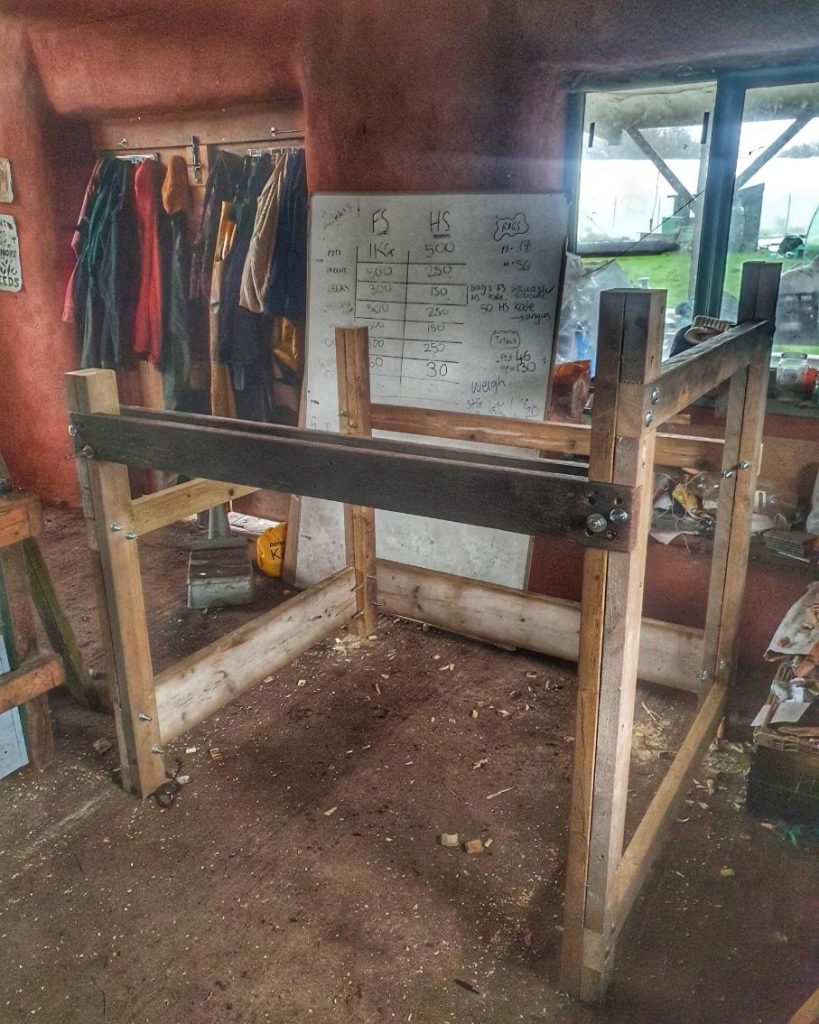
Right-ho, enough background, onto the design… I went for a cage-like design using 2×4 (plus a couple of scaff planks etc that I had lying around, but these won’t be needed in the final design). This cage gives excellent rigidity as demonstrated when I turned a 9” bowl the other day with no problems at all. All the joints can be done easily if you have access to a circular saw and pillar drill. I estimate, that the whole frame could be assembled from lengths of 2×4 in about half a day. The poppets could be used from your old lathe if you do some clever planning/ minor adjustments. The pedals are fairly quick too. So I don’t think it unreasonable to think that the whole lathe could be built in a day, which to me is plenty quick enough. The only recessed joint is on the front portion of the bed (so that the gap between the bed pieces is less than the ‘4’ of a 2×4 (if you see what I mean)). The photos below show the cage built and in action.
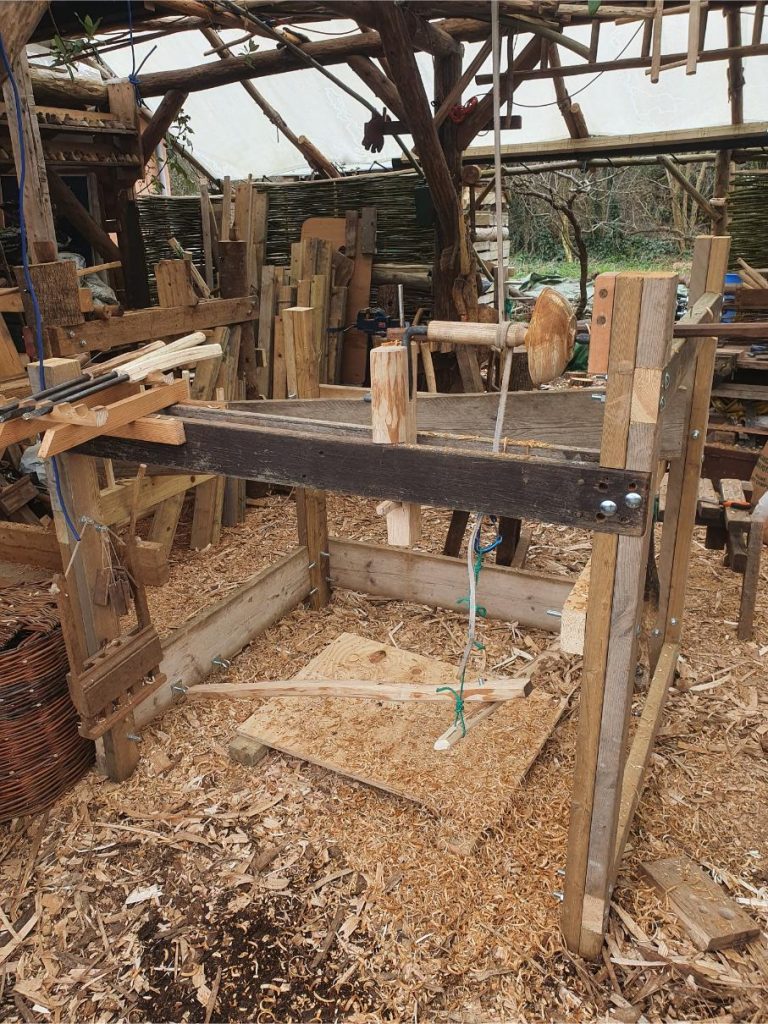
The other day I fitted a backrest to to it operating as spindle lathe, and redesigned the pedal, and wow, is it a different machine! So much easier to transfer the power and keep control of the tool as the backrest almost separates your upper body from your lower body. One of the great things about this design is that by swapping the pedals and poppets you can quickly alternate between spindle and bowl turning. Likewise a different poppet allows cups to be turned ergonomically too. I have not tried the reifendrehen technique yet on this lathe, but I imagine another poppet and potentially some tool-rest shenanigans, and it’ll work awesome too 🙂 .
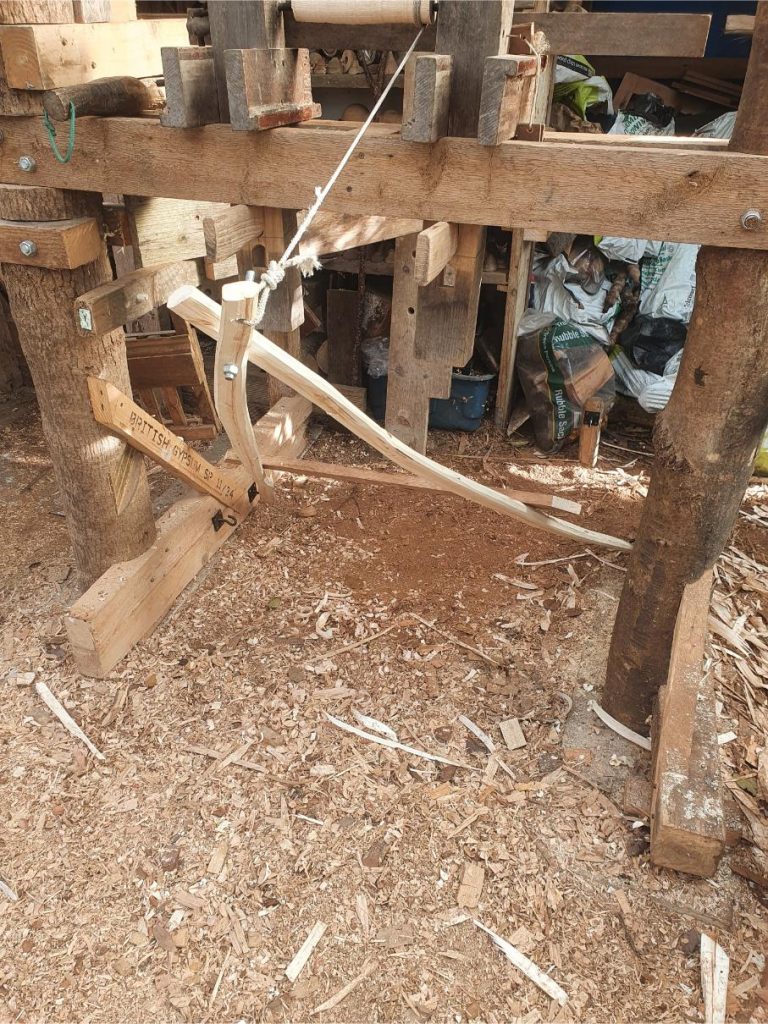
It takes about 30mins to assemble and a similar amount of time to disassemble, perfectly adequate for the events I plan on doing, and I’m sure this number will decrease as I get more practised / get a non-adjustable spanner!
A few weeks back I taught my friend Ed Tucker to turn on the lathe. I could easily adjust it for him as a 5’8” turner (I’m 6’4”). Ed has turned a couple of bowls before and found the experience much more comfortable and particularly liked the ability to press the pedal with each leg.
In terms of transport, this first version is not terribly flatpack, but in theory it should be as it is just straight bits of wood. Future versions will address this. It fits in Arthur (my Mondeo), so that is all that matters just now. In terms of weight, it is roughly twice the weight of a flatpack lathe, so less kind on fuel economy!
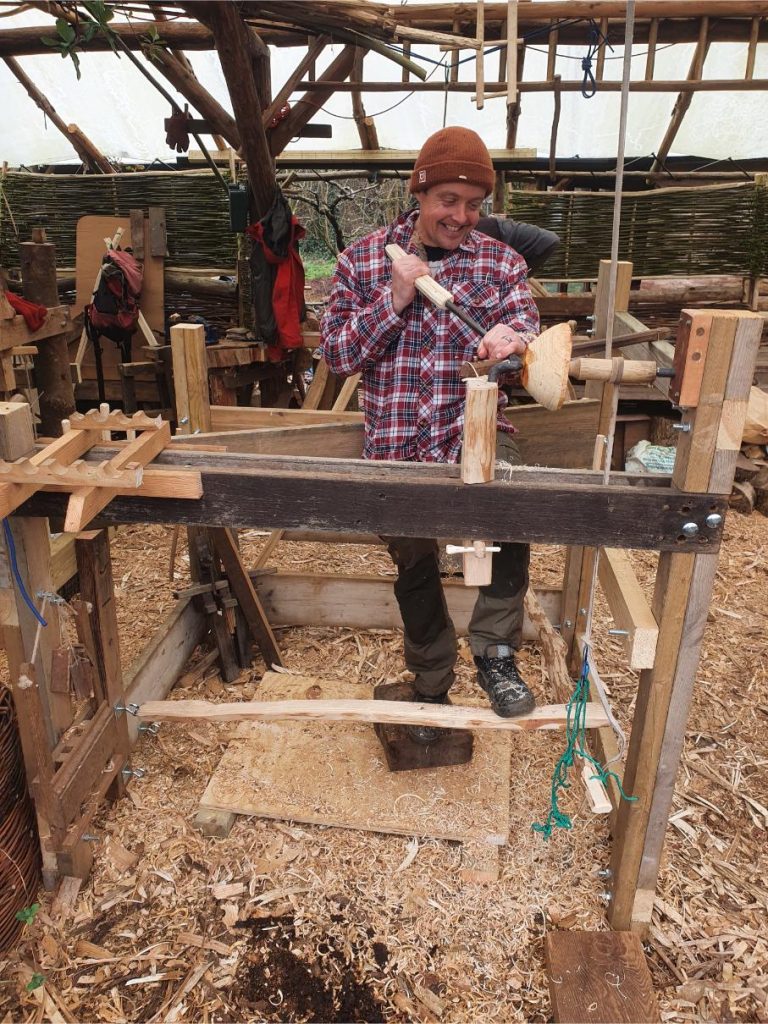
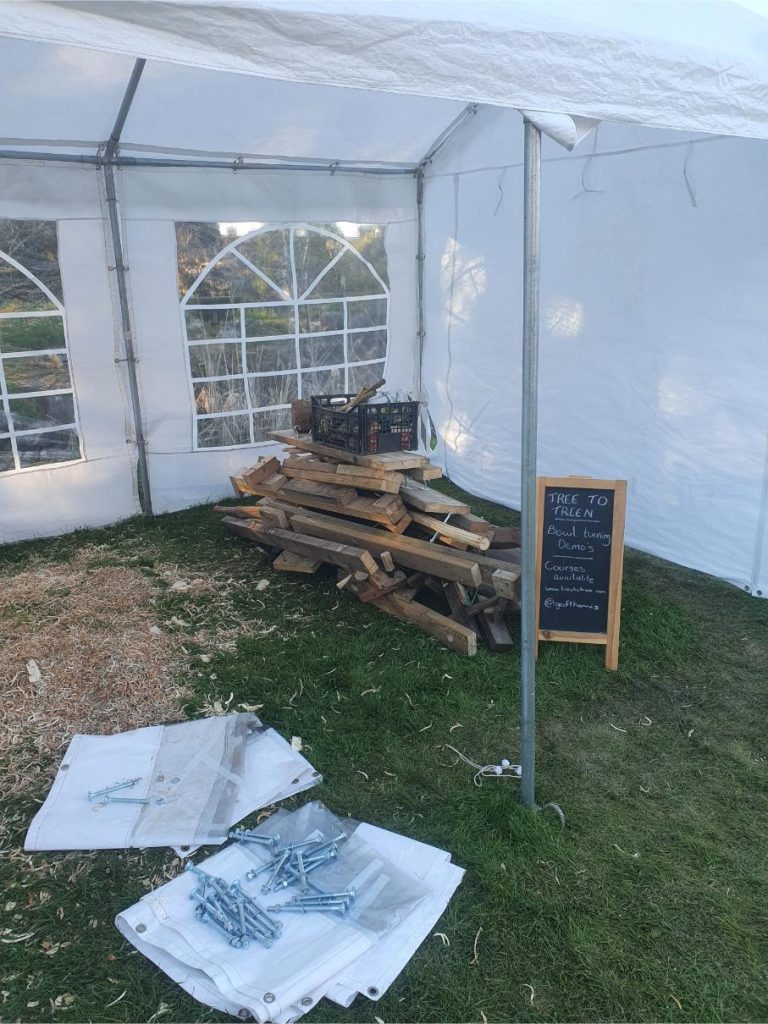
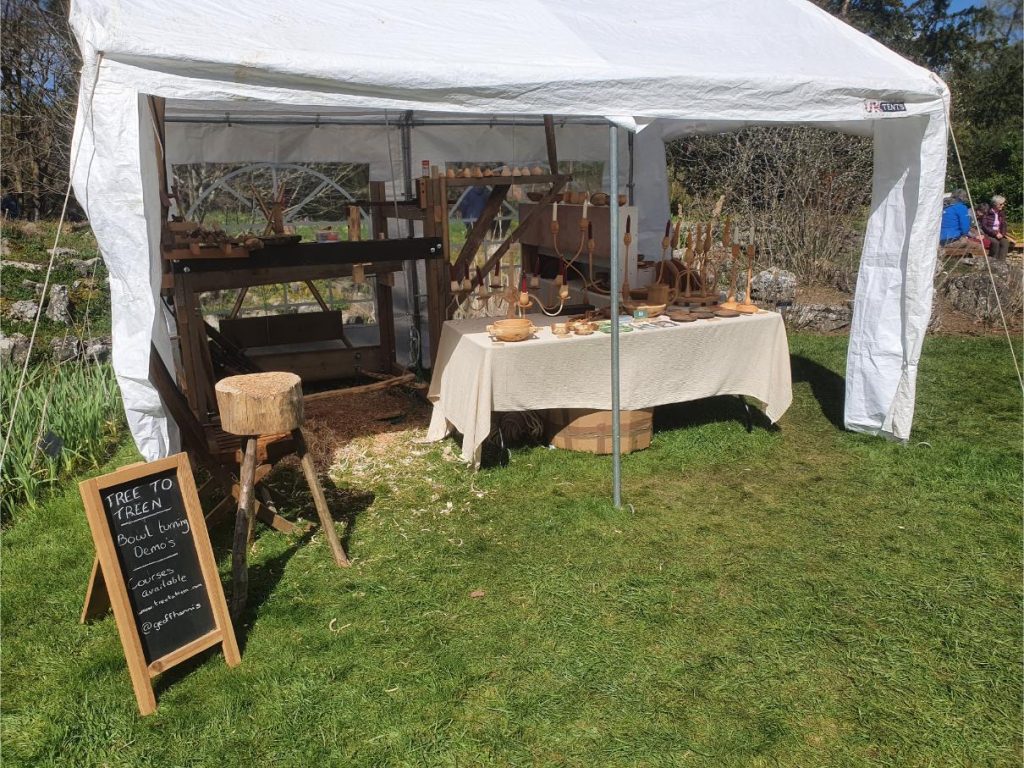
I used this at the Botanic Gardens last weekend and there is a fair amount of work that needs doing. For a start, it is too big, so I’ll slim down the dimensions so the backrest works better. Hopefully I’ll get that done before Bodger’s Ball… time for a plug… I’ll be teaching a collaborative bowl turning workshop on this lathe for two people on the Thursday, a great opportunity to get a headstart into understanding this lathe. I’ll also be doing a one hour demo at some point over the weekend which it’d be great to share with as many of you as possible. Hope to see you there!
I want to make clear at this point, most of this design is not new, in fact, it is old. George Lailey’s lathe was like a cage (albeit more triangular) with a backrest, and the same pedal arrangement. Similar examples are to be found all across Europe. I have seen lathes from Italy, Spain, Romania, Ireland, France, Germany and Sweden… they all follow this principle albeit with their own regional variations. The spindle turning pedal is taken from looking at old photos of bodgers in the woods near High wycombe .
This has been a lot of work to get to this point, and it feels like a real achievement being ready to share this with you all. Hopefully I’ll be back to making the things I want to make (comfortably) soon! Literally can’t wait to have the time and head-space to make more complex things soon!
Thanks for reading, and hope to see lots of you at the Ball! Once again, comments and kind feedback much appreciated below 🙂
Lovely read Geoff, thank you and following your research and experience while constructing this from the ground up. Crazy how much knowledge we lost.
Looking forward to see the lathe in person.
Cheers Nico, glad you enjoyed it. Look forward to seeing you at the Ball! 🙂
Great read Geoff!
Your study, time and practice put to words is a massive resource for people like me that have only started pole lathe turning roughly a year and a half ago. I took many tips from this for the new static shop lathe I’ll be building this summer. Thanks brother!
Glad you found it useful Brett. Do look out or the short ebook and plans latet this yr.
All the best, Geoff